Force Decomposition
Which part of gravity actually turns the rod?
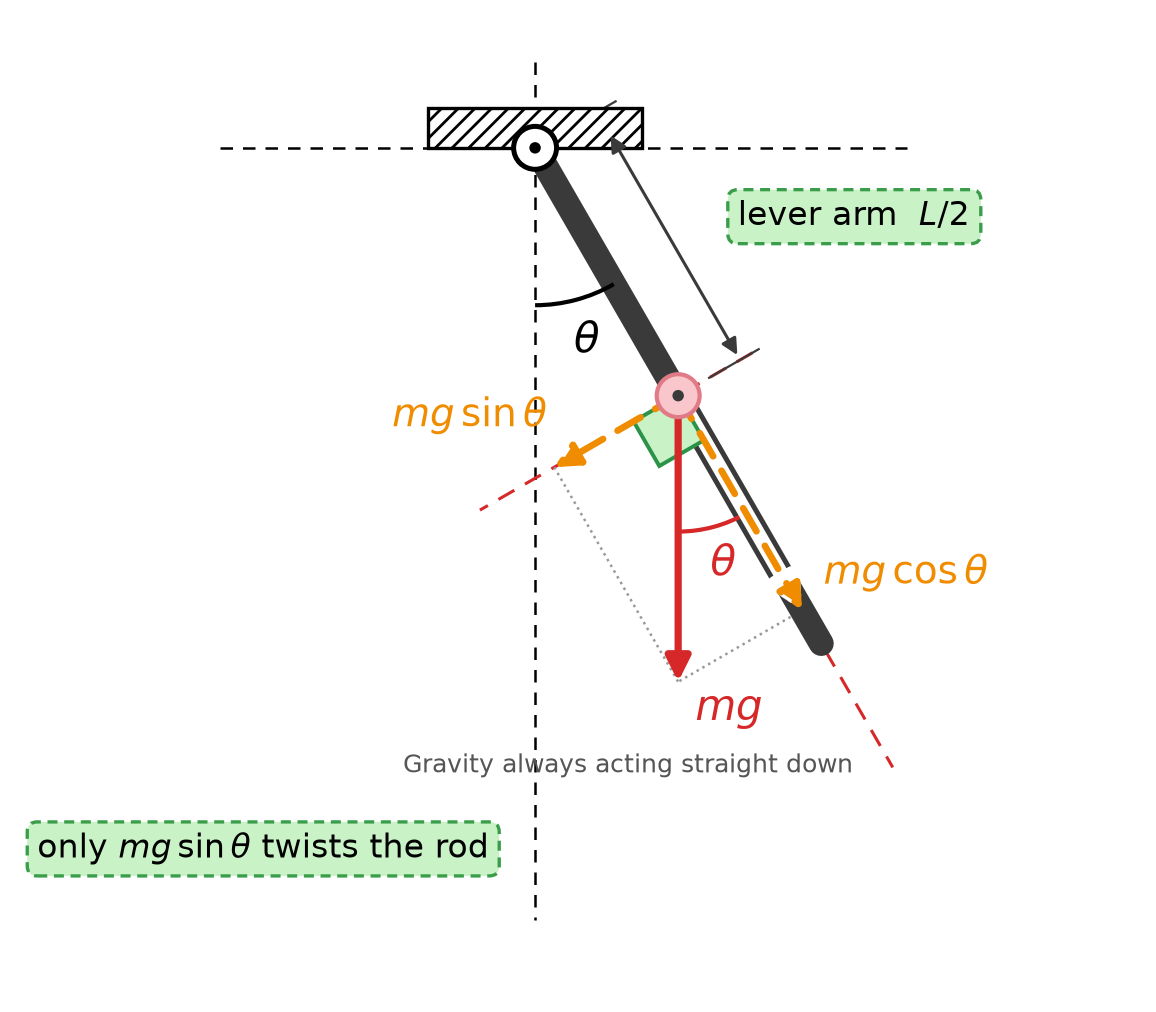
Gravity always pulls straight down, but the rod can only swing along a circle around the pivot. So the useful question is not how strong gravity is, but how much of it points along that circle.
Split the weight \(mg\) into two parts at the centre of mass, using the rod itself as the reference direction:
| Component | Direction | Size | What it does |
|---|---|---|---|
| Along the rod | Through the pivot | \(mg\cos\theta\) | Pulls on the pivot. The bearing pushes back with an equal force, so nothing moves |
| Across the rod | Along the swing | \(mg\sin\theta\) | Pushes the rod back towards the bottom |
Both come from the same right-angled triangle: \(mg\) is the hypotenuse, and \(\theta\) is the angle between gravity and the rod, so the side next to \(\theta\) is \(mg\cos\theta\) and the side opposite is \(mg\sin\theta\) (see trigonometry and vectors).
The across-the-rod part always points back towards \(\theta = 0\). Swing the rod to the right and it pushes left; swing it left and it pushes right. That is why it carries a minus sign:
\[F_{\perp} = -\,mg\sin\theta\]Two quick checks confirm it behaves sensibly:
- At \(\theta = 0\) the rod hangs straight down, \(\sin 0 = 0\), and there is no push. The rod stays put.
- At \(\theta = 90^\circ\) the rod is horizontal, \(\sin 90^\circ = 1\), and all of gravity works to swing it.
For a single point mass on a string, Newton’s second law along the swing, \(F = ma\), would finish the job here: dividing by \(m\) gives \(a = -g\sin\theta\). A rod is different. Its mass is spread from the pivot to the tip, and each part of it moves at a different speed. A force alone can’t tell us how the whole rod responds. We need to know how hard this force twists the rod, which is the next step: Torque.