Moment of Inertia
How hard is the rod to spin up?
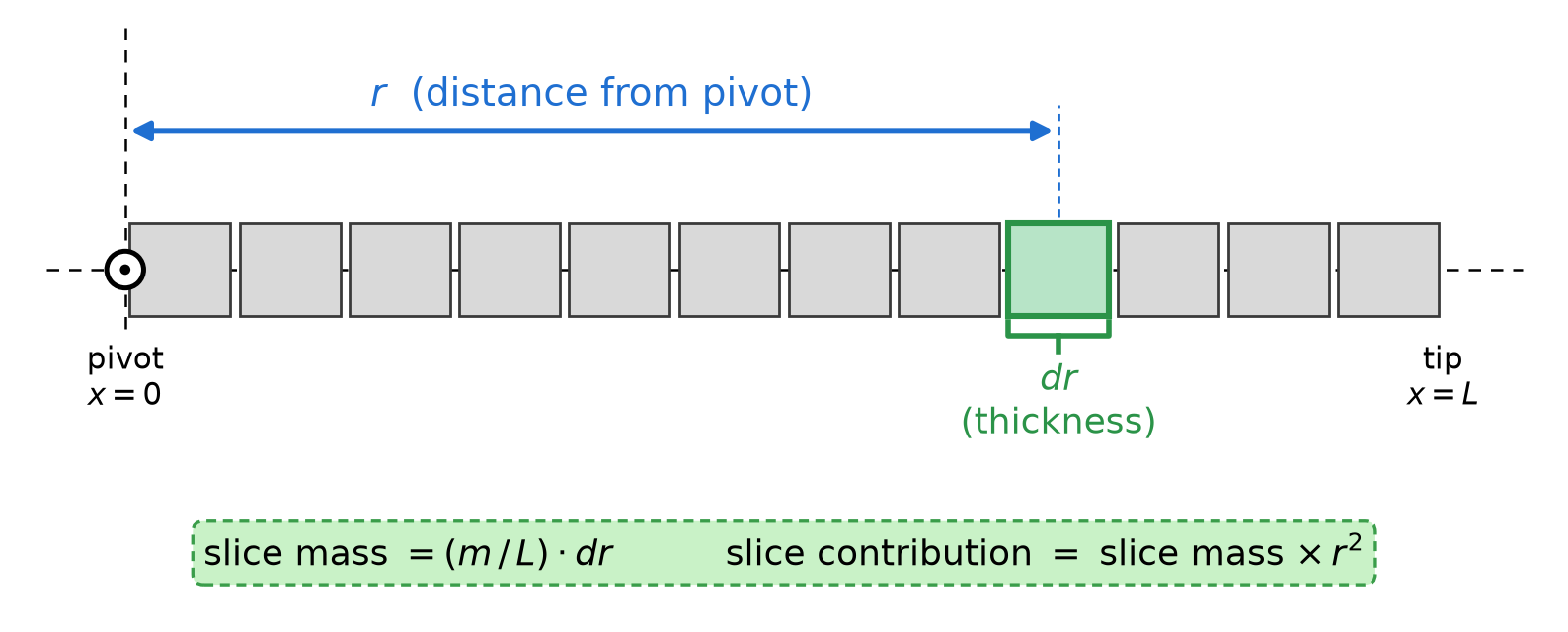
Mass resists being pushed: the heavier something is, the harder it is to speed up. Spinning has its own version of that resistance, and it depends on more than the mass. It also depends on where the mass sits. Mass far from the pivot has to travel a bigger circle in the same time, so it is much harder to get moving than mass close in.
This resistance to spinning is the moment of inertia, \(I\).
Start with one point
A single small mass \(m_i\) at distance \(r\) from the pivot has
\[I_i = m_i\, r^2\]The distance is squared. Doubling how far a piece of mass sits from the pivot makes it four times harder to spin.
Cut the rod into slices
A rod is not one point. Its mass is spread evenly from the pivot to the tip. So cut it into many thin slices, each of thickness \(dr\), and treat every slice as its own small point mass at its own distance \(r\).
Since the rod is uniform, its mass per unit length (its linear density) is the same everywhere:
\[\lambda = \frac{m}{L}\]so each slice carries a mass of
\[dm = \lambda\, dr\]Every slice adds its own \(dm\, r^2\), and the rod’s moment of inertia is the total:
\[I \approx \sum_{i} \lambda\, r_i^2\, \Delta r\]From a sum to an integral
The thinner the slices, the closer the sum gets to the real rod. In the limit of infinitely thin slices, the sum becomes an integral running from the pivot (\(r = 0\)) to the tip (\(r = L\)). See integral calculus.
\[I = \int_{0}^{L} r^2\, dm = \int_{0}^{L} \frac{m}{L}\, r^2\, dr\]The integral is nothing more than the slice sum taken to its limit.
Computing it slice by slice
The sum can be run directly, one slice at a time:
mass = 1.0            # kg
length = 0.3          # m
slices = 300
dr = length / slices  # thickness of each slice

density = mass / length
total_inertia = 0.0
distance = 0.0
for _ in range(slices):
    distance += dr
    total_inertia += density * distance**2 * dr
For a 1 kg rod, 0.3 m long, cut into 300 slices:
\[I \approx 0.03015 \ \text{kg}\cdot\text{m}^2\]Evaluating the integral
The same answer can be found by hand. Since \(\frac{m}{L}\) is identical for every slice, it factors out of the sum, just as \(3a + 3b = 3(a + b)\). What remains is the integral of \(r^2\), which is \(\frac{r^3}{3}\):
\[I = \frac{m}{L}\int_{0}^{L} r^2\, dr = \frac{m}{L}\left[\frac{r^3}{3}\right]_{0}^{L} = \frac{m}{L}\cdot\frac{L^3}{3} = \frac{mL^2}{3}\]For the same rod, \(\frac{1 \times 0.3^2}{3} = 0.03 \ \text{kg}\cdot\text{m}^2\).
Why the loop comes out slightly high
The loop places each slice’s mass at the slice’s far edge, the end furthest from the pivot. Every slice is therefore counted as sitting a little further out than it really does, and because distance is squared, each one adds a little too much. Thinner slices shrink that error:
| Slices | Slice sum (kg·m²) |
|---|---|
| 10 | 0.03465 |
| 100 | 0.03045 |
| 300 | 0.03015 |
| 1000 | 0.03005 |
| 10000 | 0.03000 |
| exact | 0.03000 |
More slices bring the sum towards the exact value, which is exactly what the integral promises.
Beyond a thin rod
The rod is thin enough to treat as a line, so one coordinate, \(r\), is enough. The same idea carries over to any real part. Cut it into small pieces of volume \(dV\) with density \(\rho\), and add up each piece’s mass times its distance from the axis squared:
\[I = \int_{V} r^2\, \rho\, dV\]A flat plate needs slices in two directions, a solid body in three, but the recipe never changes: mass times distance squared, summed over every piece.
With the torque and the moment of inertia both in hand, the last step is to put them together: Equation of Motion.